Water Resources: Types, Availability & Sustainable Use
Explore the sources, storage, availability and sustainable use of freshwater resources that support people, agriculture, ecosystems and development.
What Are Water Resources?
Water resources are the naturally occurring water sources that support ecosystems, communities, agriculture and economic activity. They include surface water in rivers, lakes and reservoirs; groundwater stored beneath the land surface; and water supplied through precipitation and the hydrologic cycle.
Water resources may be renewable, when they are replenished through the water cycle, or non-renewable, where replenishment occurs extremely slowly relative to human use. Their practical availability depends not only on total quantity, but also on location, seasonal variability, water quality, accessibility, infrastructure and environmental requirements.
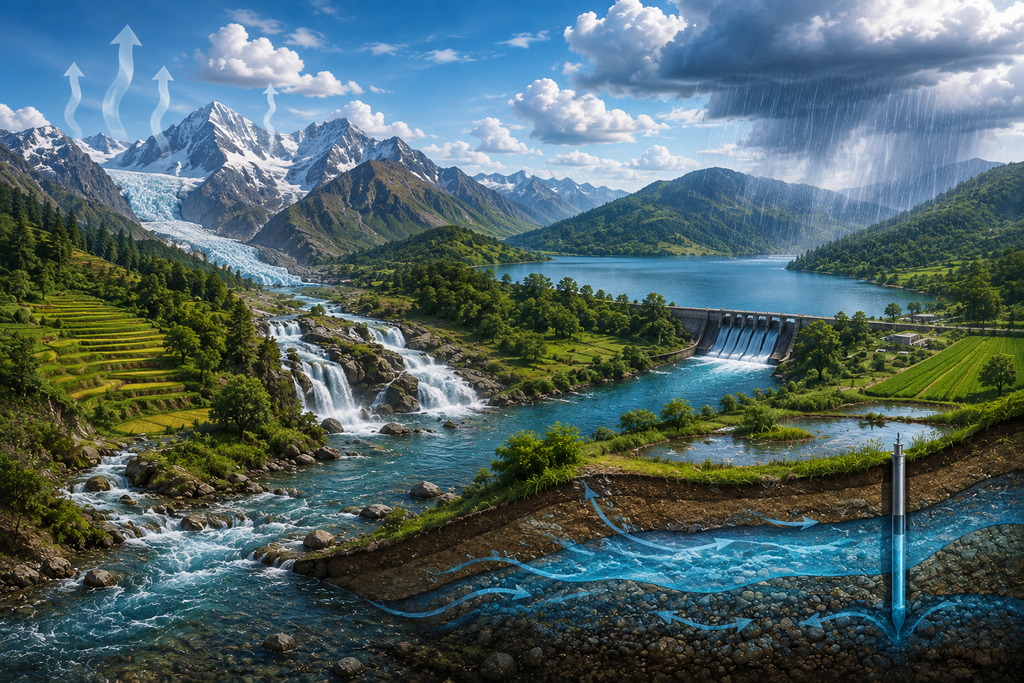
Freshwater resources occur in different forms across the Earth’s surface, beneath the ground and within the atmosphere and cryosphere. Their availability varies with climate, geography, geology, season and human use. For a clear classification, AgriHydroTech can group the principal freshwater resources into
Surface water
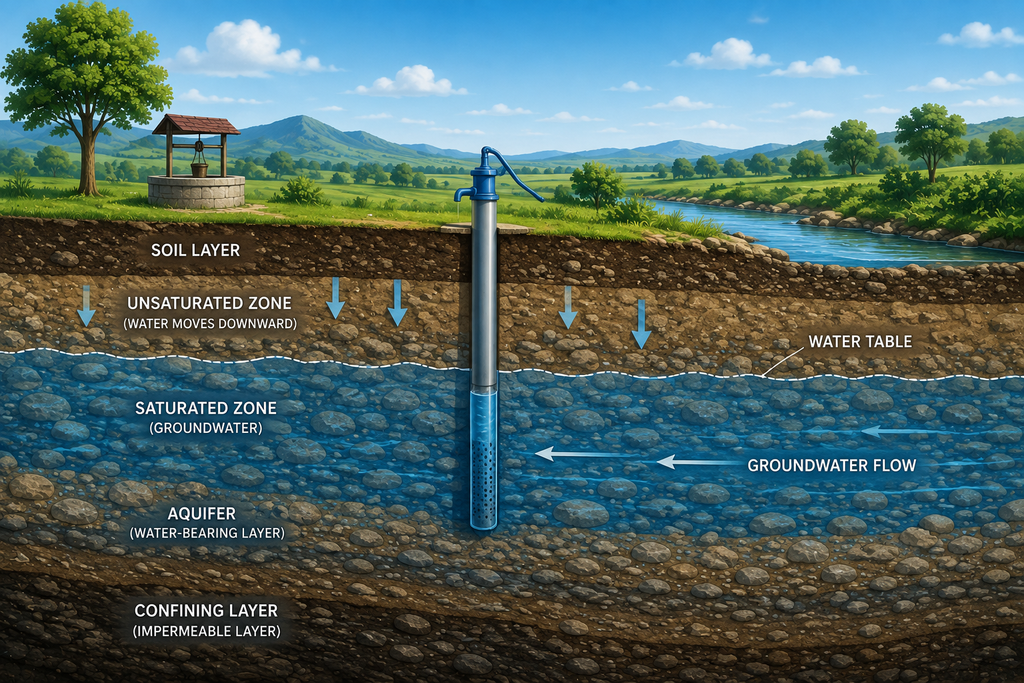
Groundwater
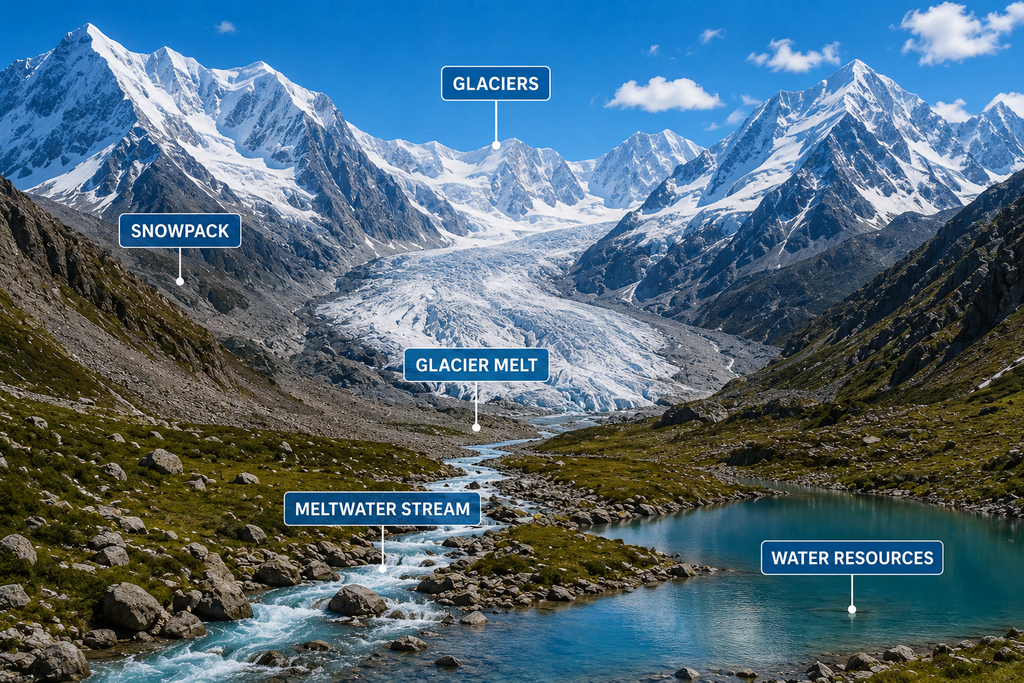
Snow & glaciers
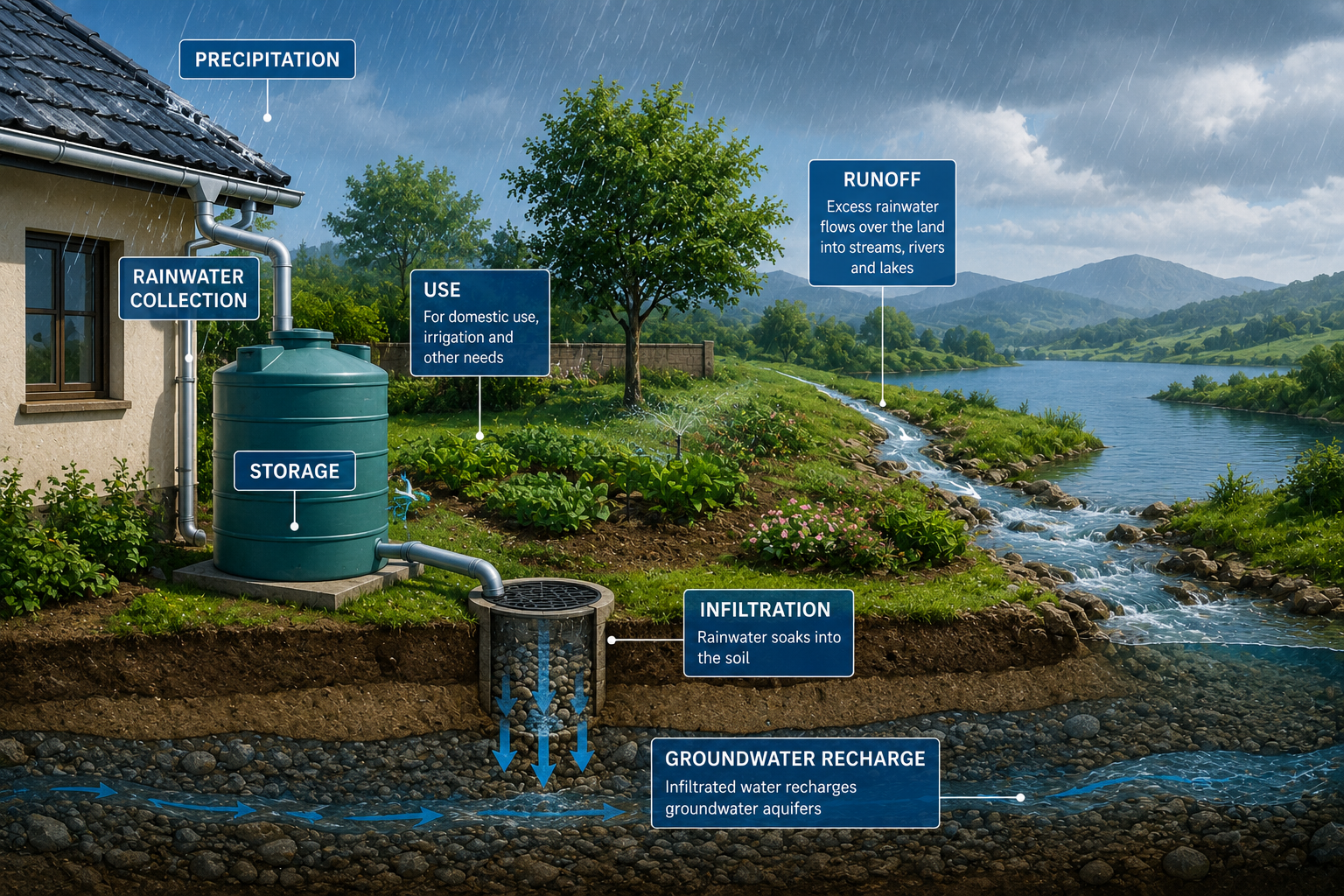
Rainwater.
Surface Water
Rivers, lakes, streams, wetlands and reservoirs that store and convey freshwater across the landscape.
Groundwater
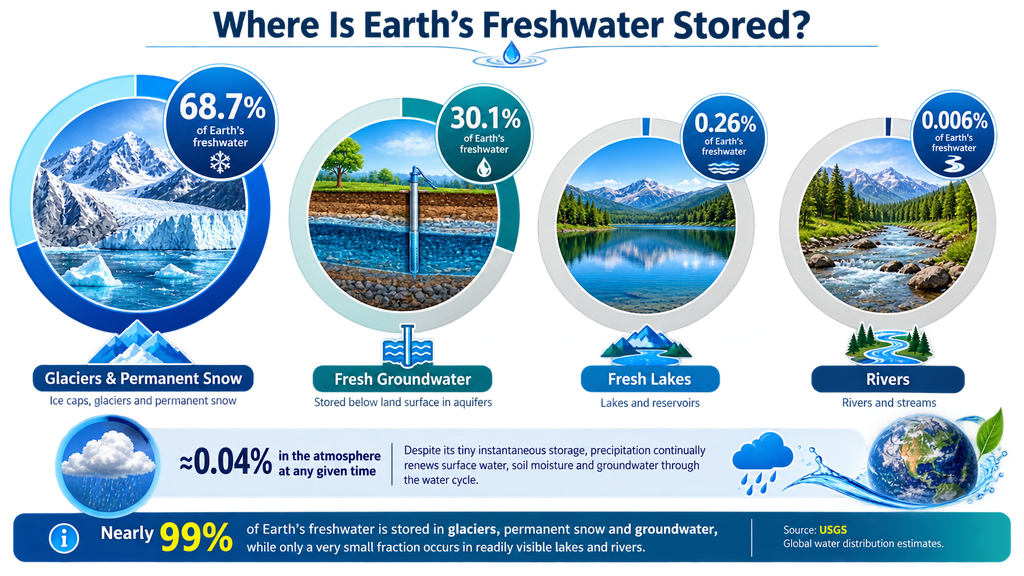
Freshwater stored below the land surface in aquifers and replenished through groundwater recharge.
Snow & Glaciers
Natural frozen-water storage that releases freshwater through seasonal snowmelt and glacier melt.
Snow & Glaciers
Natural frozen-water storage that releases freshwater through seasonal snowmelt and glacier melt.
1. Surface Water
Surface water resources are freshwater bodies found on or flowing across the Earth’s surface, including rivers, streams, lakes, wetlands and reservoirs. They are replenished mainly by precipitation, surface runoff, snowmelt and, in many locations, groundwater discharge.
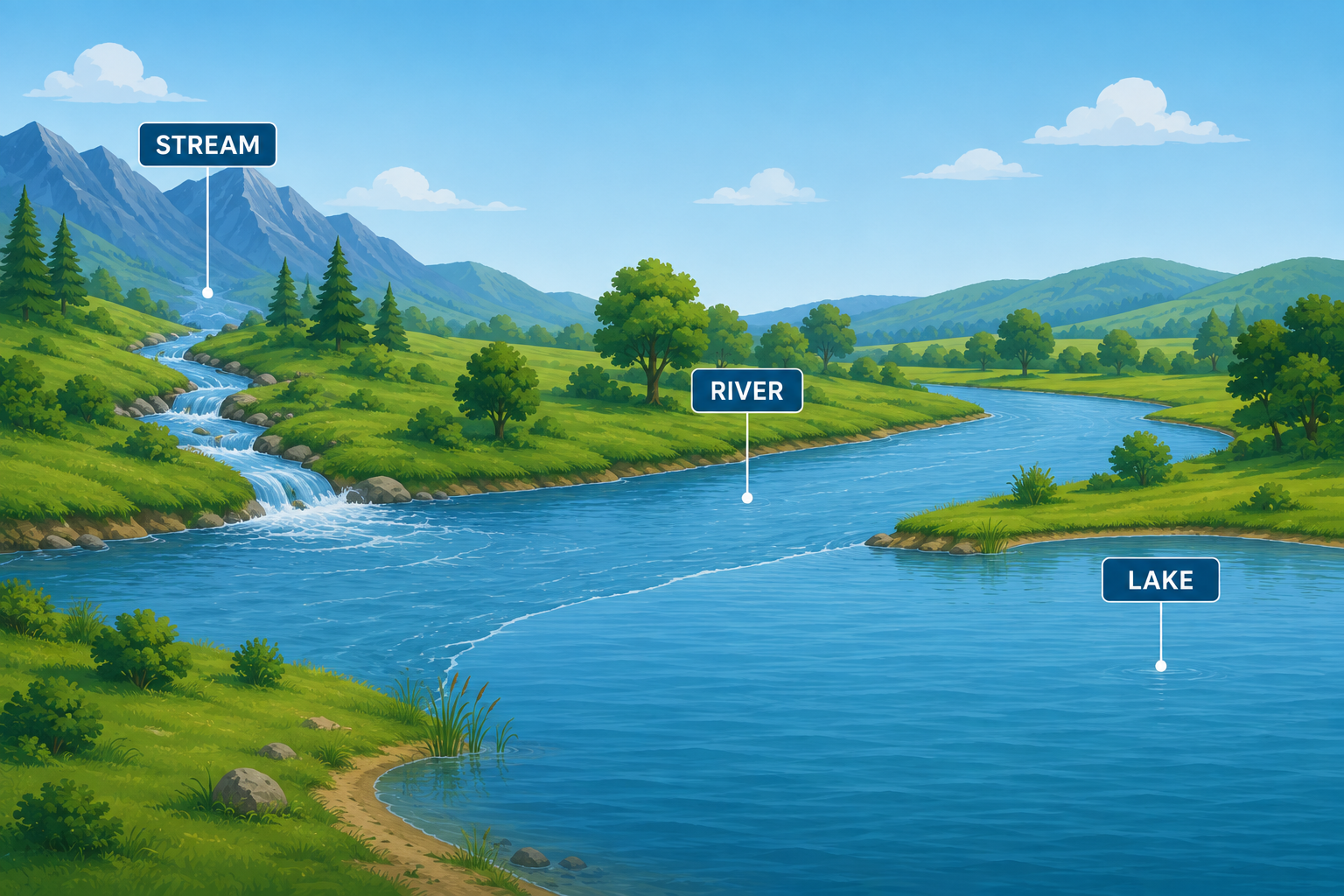
Rivers and streams collect and convey water through drainage basins or watersheds. Their flows may vary substantially between wet and dry seasons and from year to year, depending on rainfall, snow and glacier melt, catchment characteristics, groundwater interaction and upstream water use.
Lakes and wetlands provide natural freshwater storage and important ecological functions, while reservoirs provide engineered storage that can regulate variable river flows. Stored surface water may support municipal and industrial water supply, irrigation, hydropower generation and other beneficial uses. Reservoirs can also contribute to flood management, although their functions depend on their design and operating rules.
The availability of surface water is determined not only by the total volume of water in a river basin but also by its seasonal distribution, storage capacity, water quality, environmental requirements and competing demands. Sustainable surface-water management therefore requires an understanding of both natural hydrology and human water use.
Key Surface Water Resources
Rivers & Streams — flowing freshwater systems Lakes & Wetlands — natural surface-water storage and ecosystems Reservoirs — managed storage of river and runoff water Runoff — precipitation or meltwater flowing across the land surface
2. Groundwater
Groundwater resources consist of water stored beneath the land surface within pores, fractures and openings in soil, sediments and rocks. Geological formations capable of storing and transmitting useful quantities of groundwater are known as aquifers.
Groundwater is replenished through recharge, which occurs when rainfall, surface water or irrigation water infiltrates through the soil and reaches the saturated zone. Recharge rates vary according to climate, rainfall, geology, soil characteristics, vegetation and land use. Groundwater may also interact directly with rivers, lakes and wetlands.
Groundwater provides an important source of water for drinking, irrigation, industry and rural communities, particularly where surface-water supplies are limited or highly seasonal. UNESCO reports that groundwater provides about half of the volume of water withdrawn for domestic use globally and around 25% of all water withdrawn for irrigation.
When groundwater abstraction persistently exceeds replenishment, groundwater levels may decline. Long-term over-abstraction can contribute to depletion of aquifer storage, reduced flows to connected rivers and wetlands, land subsidence in susceptible areas, increased pumping costs and deterioration of water quality. Sustainable groundwater management therefore requires monitoring abstraction, recharge, groundwater levels and quality.
Key Groundwater Concepts
Aquifer — geological formation that stores and transmits groundwater Water Table — upper surface of the saturated groundwater zone Recharge — water entering and replenishing an aquifer Abstraction — groundwater withdrawn through wells or other means Groundwater Level — an important indicator for monitoring changes in aquifer storage
3. Snow & Glacier
Snow and glaciers form important natural freshwater stores in mountain and high-latitude regions. Seasonal snowpack temporarily stores precipitation during colder periods and releases water during snowmelt, while glaciers can store frozen freshwater over much longer timescales.
Snowmelt and glacier melt contribute to streamflow and can be particularly important in river basins where downstream communities, agriculture, ecosystems, reservoirs and hydropower systems depend on water originating in high mountain regions.
The timing and magnitude of meltwater depend on temperature, snowfall, elevation, solar radiation and other climatic conditions. Changes in snow accumulation and glacier mass can therefore affect the seasonal timing and long-term reliability of downstream water resources
Rainwater is freshwater supplied directly through precipitation and represents a fundamental input to terrestrial water resources. After rainfall reaches the land surface, part may infiltrate into the soil, recharge groundwater, become surface runoff, enter rivers and lakes, or return to the atmosphere through evaporation and plant transpiration.
Rainwater can also be captured and stored through rainwater harvesting systems. Depending on local conditions, harvested rainwater may supplement domestic supplies, landscape irrigation, agricultural use or groundwater recharge.
The usefulness of rainwater as a resource depends on rainfall amount, intensity, seasonal distribution, catchment characteristics, storage capacity and water quality. In areas with highly variable rainfall, effective collection and storage can help make water available beyond the period in which the rainfall actually occurs. Key-points Precipitation • Rainfall • Rainwater Harvesting • Runoff • Infiltration • Recharge • Storage
Surface Water vs Groundwater
Surface water and groundwater are two major components of freshwater resources. Surface water occurs in rivers, streams, lakes, wetlands and reservoirs, while groundwater is stored below the land surface within aquifers. Although they are often described separately, the two resources are interconnected through infiltration, recharge, groundwater discharge and exchanges between aquifers and surface-water bodies.
Feature
Surface Water
Groundwater
Location
Rivers, streams, lakes, wetlands and reservoirs
Below the land surface in aquifers
Main storage
Natural and engineered surface-water bodies
Pores and fractures in soil, sediments and rock
Replenishment
Rainfall, runoff, snow/glacier melt and groundwater discharge
Infiltration and recharge from rainfall and surface water
Response to climate
Often responds relatively quickly to rainfall and drought
Generally responds more slowly, depending on the aquifer
Seasonal variability
Often relatively high
Usually more buffered, but varies by aquifer
Access
Intakes, diversions, canals and reservoirs
Wells, tube wells and springs
Major quality risks
Pollution, sediment, nutrients and contaminated runoff
Salinity, geogenic contaminants and pollutants entering through recharge
Overuse impacts
Reduced river/lake levels and environmental flows
Falling water tables, depletion, reduced baseflow and possible land subsidence
Management need
Flow, storage, allocation and quality management
Recharge, abstraction, groundwater-level and quality management
Surface water and groundwater are not independent resources. Pumping groundwater can reduce discharge to rivers and wetlands, while changes in river levels can affect groundwater recharge and groundwater levels. Effective water-resource planning should therefore consider both as parts of an interconnected system.
Water resources can also be classified according to how quickly they are replenished. Renewable water resources are regularly replenished through the hydrologic cycle, while non-renewable water resources are stored over very long periods and receive little or negligible recharge on a human timescale.
Renewable Water Resources
Renewable water resources are replenished naturally through precipitation, runoff, snow and glacier melt, groundwater recharge and other processes of the water cycle. Rivers, lakes and shallow aquifers may therefore contain renewable water, although their rate of replenishment varies greatly between regions and seasons.
Non-renewable water resources are water reserves that receive negligible recharge compared with the rate at which they may be used. The most important example is fossil groundwater stored in deep aquifers, often accumulated under climatic conditions that existed thousands of years ago.
Examples: Fossil groundwater • Deep aquifer reserves with negligible modern recharge
Renewable does not mean unlimited. A renewable water resource can still be depleted or become unsustainable when withdrawals consistently exceed replenishment, environmental requirements or the resource’s capacity to recover.
Cookie Consent
We use cookies to improve your experience on our site. By using our site, you consent to cookies.
Contains information related to marketing campaigns of the user. These are shared with Google AdWords / Google Ads when the Google Ads and Google Analytics accounts are linked together.
90 days
__utma
ID used to identify users and sessions
2 years after last activity
__utmt
Used to monitor number of Google Analytics server requests
10 minutes
__utmb
Used to distinguish new sessions and visits. This cookie is set when the GA.js javascript library is loaded and there is no existing __utmb cookie. The cookie is updated every time data is sent to the Google Analytics server.
30 minutes after last activity
__utmc
Used only with old Urchin versions of Google Analytics and not with GA.js. Was used to distinguish between new sessions and visits at the end of a session.
End of session (browser)
__utmz
Contains information about the traffic source or campaign that directed user to the website. The cookie is set when the GA.js javascript is loaded and updated when data is sent to the Google Anaytics server
6 months after last activity
__utmv
Contains custom information set by the web developer via the _setCustomVar method in Google Analytics. This cookie is updated every time new data is sent to the Google Analytics server.
2 years after last activity
__utmx
Used to determine whether a user is included in an A / B or Multivariate test.
18 months
_ga
ID used to identify users
2 years
_gali
Used by Google Analytics to determine which links on a page are being clicked
30 seconds
_ga_
ID used to identify users
2 years
_gid
ID used to identify users for 24 hours after last activity
24 hours
_gat
Used to monitor number of Google Analytics server requests when using Google Tag Manager
1 minute
SourceBuster is used by WooCommerce for order attribution based on user source.
Name
Description
Duration
sbjs_session
The number of page views in this session and the current page path
30 minutes
sbjs_udata
Information about the visitor’s user agent, such as IP, the browser, and the device type
session
sbjs_first
Traffic origin information for the visitor’s first visit to your store (only applicable if the visitor returns before the session expires)
session
sbjs_current
Traffic origin information for the visitor’s current visit to your store
session
sbjs_first_add
Timestamp, referring URL, and entry page for your visitor’s first visit to your store (only applicable if the visitor returns before the session expires)
session
sbjs_current_add
Timestamp, referring URL, and entry page for your visitor’s current visit to your store
session
sbjs_migrations
Technical data to help with migrations between different versions of the tracking feature